
NIS2: Who Actually Has to Comply, What It Costs to Ignore and Why Nmap/AI Can't Prove It for You
A sourced walk through NIS2: who is in scope and what the fines really are, whether you need a certified auditor, and why the wave of nmap/Kali/AI 'NIS2 checkers' can't produce compliance evidence - with a full, control-by-control table of all 226 requirements mapped against Pentesterra, Nmap+NSE and AI-wrapped Kali.
Half the questions I get about NIS2 are some version of "do we actually have to do this, or is it another directive that sits in a drawer?"
Short answer: you have to do it, the drawer option expired, and the tools being sold to make it painless mostly can't.
Let's take that apart, with sources, and end somewhere useful.
NIS2 is Directive (EU) 2022/2555. A directive is not a regulation, so it does not bite you directly. It binds you through your own country's law, the way GDPR does. That single fact is behind most of the confusion, and it is where we should start, because "for whom is this mandatory" has a precise answer and "what happens if you ignore it" has numbers.
I've spent the last stretch reading the actual legal text, the Commission's implementing regulation, and the national transpositions, and then mapping all of it against what security tools can and can't do. This post is that work, in four parts, and then an honest pitch for where Pentesterra fits. Every claim links to a source. I would rather you check them.
Part 1: Who has to comply, and what it costs to ignore
The two-part test
You are in scope if both are true:
- you operate in one of NIS2's 18 sectors, and
- you are at least a medium-sized company.
The sectors come from two annexes:
- Annex I (high criticality): energy, transport, banking, financial market infrastructure, health, drinking water, waste water, digital infrastructure, ICT service management (managed service and managed security providers), public administration, space.
- Annex II (other critical): postal and courier, waste management, chemicals, food, manufacturing (medical devices, electronics, machinery, vehicles), digital providers (marketplaces, search engines, social networks) and research.
"Medium-sized" follows the EU SME definition: from 50 staff, or annual turnover and balance sheet both over 10 million euro. Below that you are usually out, with exceptions that ignore size entirely:
- DNS providers, TLD registries, trust service providers and public electronic communications;
- anyone a member state names as sole or critical provider (NIS2 Art.2 and Art.3);
- if you sell across the EU but sit outside it, you still need an EU representative (Art.26).
Essential vs important is not a compliment, it's your supervision regime
NIS2 splits in-scope entities into essential and important. It is not a ranking of how good your security is. It decides how the regulator watches you and how hard they can hit you.
Essential entities get proactive supervision: on-site inspections, random checks, regular and targeted audits, and, in the text itself, "security scans" (Art.32(2)). Important entities get reactive supervision, triggered when there is an indication something is wrong (Art.33). Either way, management bodies must approve the security measures, oversee them, and can be held personally liable (Art.20). That last part is why boards started paying attention.
So has anyone actually been fined?
Here is the honest version, because you'll see scarier claims. There is not yet a long public list of NIS2 fines. The reason is timing: the transposition deadline was 17 October 2024, and most countries missed it. In July 2026 the Commission took Ireland, Spain, France and the Netherlands to the EU Court of Justice for still not having transposed, asking for lump-sum and daily penalties. So the enforcement machine is only now switching on.
What is real and dated is the exposure. Germany's law (NIS2UmsuCG) came into force in December 2025, and the number of supervised entities jumped from about 4,500 to roughly 29,500, with a registration deadline in March 2026. Belgium requires its essential entities to have a conformity assessment under way by 18 April 2026. Italy's ACN set significant-incident reporting from 1 January 2026 and baseline measures for most listed entities by around 31 October 2026. The fines are not hypothetical, they are scheduled.
The takeaway for Part 1: if you are a medium or larger company in one of the 18 sectors, this is mandatory now, the penalties reach into eight figures and into your executives personally, and the countries that were slow are being pushed by the Court. The drawer is closed.
Part 2: Do you need a certified auditor to "get NIS2 certified"?
Short version: there is no EU "NIS2 certificate." NIS2 works like GDPR: you have to be compliant and be able to show it when the authority asks, and nobody hands you a certificate that ends the conversation. This is in the text, not my reading of it. The directive makes cybersecurity certification explicitly voluntary - a member state may require you to use certified products or services under a European scheme, but there is no "certified NIS2" status for the entity (Directive Art.24). What actually binds you is the duty to produce "evidence of implementation ... and the respective underlying evidence" when the authority asks (Art.32(2)(g), 33(2)(f)) - the same be-compliant-and-demonstrate-it model as GDPR's accountability principle.
A few things follow from that, and they are worth getting right because vendors blur them.
- The Commission implementing regulation (CIR 2024/2690) spells out the technical and methodological measures in a 13-section annex of roughly 160 numbered requirements. It is directly binding on digital-infrastructure providers (DNS, cloud, data centres, MSPs, and so on). For everyone else the detailed measures come from national law, but the CIR annex, mirrored by ENISA's June 2025 implementation guidance, is the practical reference. That is the structure this whole analysis is built on.
- Who checks you is your national authority: ACN in Italy, BSI in Germany, CCB in Belgium. Essential entities are checked proactively, important ones after a signal (Art.32 and 33). Targeted audits by an independent body are paid by the audited company (Art.32(2), 33(2)). Read that twice: the audit is on your bill.
- "Certified auditor" is not the same as "certified you." Expect vendors to wave credentials around, so separate two things they blur. A person or firm can hold audit qualifications (CISA, ISO 27001 Lead Auditor) or be an accredited conformity-assessment body, and for a targeted audit NIS2 does require a qualified independent body (Art.32(2)(e)) - whose bill you pay. None of that changes what the tool in the engagement produces: no credential turns a banner-grabbing scan into reproducible evidence, and no private auditor issues a state "NIS2 certificate" - the national authority supervises, and the auditor's report is one input to it. So when a service is sold as "assessment by certified auditors," the question that matters is what evidence the assessment actually leaves behind, not whose signature is on the cover.
- ISO 27001 is not automatically NIS2. It covers most of the Art.21 areas and is a strong evidence base, but it does not cover the Art.23 reporting timelines, national registration, or the specific management-liability duties. Belgium formally accepts ISO 27001 (with the right scope and Statement of Applicability) or its own CyberFundamentals framework as a route. Germany only forces recurring proof (every three years, via audit or certification) on critical-infrastructure operators, not on every entity.
- Something is coming, but it is not here. The direction of travel is simplification and certification. The Commission's Digital Omnibus (19 November 2025) already unified incident reporting and clarified how NIS2 sits next to the CER Directive and DORA. Then on 20 January 2026 it proposed a full cybersecurity package: targeted NIS2 amendments plus a revised Cybersecurity Act. The headline for compliance is a cyber-posture certificate - the Commission wants entities to "certify their cyber posture ... [and] get presumption of conformity with NIS2 and other Union legislations." An essential entity holding one could be spared targeted audits for the covered requirements, but only where the certificate comes from a third-party conformity assessment body (Art.78(2) of the revised Act), and "on-site inspections, security scans, or targeted information requests ... remain available." The same package narrows scope for about 28,700 companies (6,200 of them micro and small) and adds a small mid-cap category covering another 22,500. Separately, NIS2's own review clause (Art.40) has the Commission reporting by 17 October 2027, with a legislative proposal attached "where necessary." None of it is law: the certification scheme does not exist yet, ENISA has to build a candidate "within one year as a rule," and adoption is not expected before late 2026 or 2027. If anything it sharpens the point - even the exemption being drafted is a certificate from an accredited body, not a clean scan. Do not plan around it yet.
Can you self-certify and put up a "NIS2 Compliant" badge?
Short answer: no, and doing it anyway is its own legal exposure, separate from anything NIS2 itself does to you.
There is no self-issued "NIS2 Compliant" seal, because there is no self-issued EU cybersecurity certificate of any kind. A certificate that means something comes from a European cybersecurity certification scheme adopted under the Cybersecurity Act, Regulation (EU) 2019/881, and that scheme has a specific chain of custody. Certification is voluntary - "the cybersecurity certification shall be voluntary, unless otherwise specified by Union law or Member State law" (Art.56(1)) - but the moment a scheme requires assurance level "high," the certificate itself "is to be issued only by a national cybersecurity certification authority or," in narrow cases, a conformity assessment body that authority has specifically pre-approved or delegated to (Art.56(6)). A company writing its own report card is not anywhere in that chain.
Put a badge up anyway and you're not just overstating, you land inside the EU's general consumer-protection blacklist. The Unfair Commercial Practices Directive (2005/29/EC) lists, in Annex I, practices that are misleading "in all circumstances" - no case-by-case balancing test, no defence that it was substantially true. Point 1 of that list: "Claiming to be a signatory to a code of conduct when the trader is not." Point 2: "Displaying a trust mark, quality mark or equivalent without having obtained the necessary authorisation." A self-drawn "NIS2 Compliant" shield, with no accredited body behind it, is point 2, described almost exactly.
So the honest version of a "NIS2 badge" isn't a badge. It's the evidence base itself - an assessment your own management, a customer's security team, or an auditor can actually open and inspect, findings and documented answers attached. That claim survives scrutiny. A shield with nothing behind it is a claim someone else's regulator gets to unpick for you.
So the practical question is not "who certifies me" but "who assembles the evidence." An accredited auditor issues the final opinion where one is required. Before that, someone has to produce the evidence base: the technical findings, the tested controls, the documented answers for everything a scan can't see. That "someone" is where a tool, a service, or a platform earns its keep. Which brings us to the tools.
Part 3: The market is full of "NIS2 checkers." Most of them can't check NIS2
Every few weeks a new product appears that promises a NIS2 assessment from a
button. Strip the interface and it is almost always the same open-source
stack: nmap and NSE scripts for the network, a few Kali tools, and lately an
LLM agent driving all of it. There are real, shipping examples of the pattern,
like mcp-kali-server ("run nmap, nxc or any other tool" from a chat client)
and hexstrike-ai ("autonomously run 150+ cybersecurity tools", installable
with apt install).
I like these tools. I've used all of them for years, and Pentesterra uses the same primitives under the hood. The problem is not the tools. The problem is the claim that their output is NIS2 evidence. It isn't, and here is the sourced reason, in three layers. (For the deeper teardown of why these scanners miss vulnerabilities in the first place, I wrote a separate sourced piece.)
Layer 1: coverage. Most of NIS2 isn't scannable at all
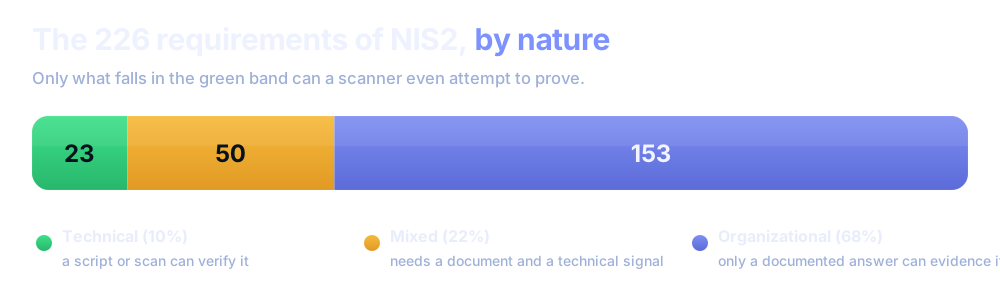
First, the distinction the rest of this section rests on. A technical control is one you can prove by running something: a script, a scan, a check that returns a fact about the system - is TLS 1.2+ enforced, is this port closed, is that CVE patched. An organizational control is a matter of process, policy and people: that a SIEM exists and log sources are correctly classified, that management reviewed the risk treatment, that staff are trained, that suppliers signed incident clauses. You cannot run a check for those - the evidence is a document and an attestation, not a scan result. A mixed control is one where a scan gives a partial signal but a document still has to carry the rest. This is not a Pentesterra opinion; it is the shape of the standard.
I mapped all 226 requirement lines (the CIR annex plus directive-level duties) by nature. 153 are organizational - policies, reviews, contracts, training, physical security, governance, and everything that lives in a SIEM or a logbook rather than on a port. 50 are mixed. Only 23 are purely technical. No scanner, however clever, produces evidence that your backups were test-restored, that supplier contracts carry incident clauses, or that the board approved the security policy. The best it can do is write a sentence claiming so, which is exactly the thing an auditor exists to disprove. That caps a pure scanner at roughly 73 lines before you even ask how well it does them.
Layer 2: Nmap is a fine port scanner and a poor compliance tool
Checked against a live install: Nmap 7.98 ships 613 NSE scripts, and 211 of them are tagged intrusive. It does a genuinely good job on a handful of NIS2-relevant facts: TLS and SSH cipher strength, SMB signing, clear-text admin protocols, exposed services. That is about 8 of the 226 lines verified cleanly. Roughly 38 more get a partial signal the same way - a cipher list, a banner, an open port that hints at a mixed control - real data, but not by itself the recorded, criticality-rated finding CIR 6.5.2 asks for; a person still has to read it, corroborate it and write it up.
That eight-line win is also not free. Reaching it requires knowing which of 613 scripts maps to which control, invoking each one with the right script arguments, timing template and safety flags for that specific target, reading the raw text output correctly instead of trusting a version banner, and then writing the whole exercise up as a documented methodology with a criticality rating per finding, because Nmap's own output is an XML dump, not a report. Get an argument wrong on one of the 211 intrusive scripts and the failure mode is not quiet: NSE's own documentation warns some of them can crash a service or trip an IDS on a production target. Knowing which script, which flags, which target it is safe to run against, and then writing the result up to CIR 6.5.2's standard, is a penetration tester's job. It is exactly the qualification and the paperwork a "just run nmap yourself" shortcut is trying to avoid paying for, and skipping either one is what turns even this narrow eight-line win into something an auditor can't use: the first question is "show me the methodology," and a terminal history is not one.
Then it runs out. There is no NSE script for SPF, DKIM, DMARC, MTA-STS,
DANE, RPKI, MFA, SSO, OAuth, SAML, JWT, WebAuthn or a security.txt disclosure
channel - the exact controls a compliance check needs most. Its CVE output
(vulners) is banner-based: it matches the version string against a
remote database. Red Hat says the consequence plainly - tools that decide
"based solely on the version number ... can result in false positives as they
do not account for backported security fixes." This isn't theoretical: Nmap's
own issue tracker has an open, unresolved report of exactly that failure mode
- a patched SUSE (SLES) OpenSSH build still flagged with the full CVE list for its base version, the reporter concluding "it is not possible to check OpenSSH patches (or Linux version) with vulners script so these false positive findings can not be avoided." Hand that raw list to an auditor as your patch-management evidence and you have handed them a list they cannot trust. And Nmap keeps no evidence store: each run is a standalone XML file, no history, no re-test, no criticality or remediation record. CIR 6.5.2 asks for tests documented "including assessment of criticality and mitigating actions for each finding." Raw XML is not that.
Layer 3: the AI agent adds reach, and takes away evidence
An LLM driving Kali reaches further than bare Nmap. But three properties make its output unusable as evidence, no matter how good the model is.
It is not reproducible. Reproducibility is the base property of evidence. LLM inference doesn't have it, even at temperature 0. Thinking Machines Lab showed in 2025 that the same prompt sent a thousand times "returns dozens of different responses," because server-side batching changes the numerical path. An assessment you can't reproduce is a sample, not an audit.
Its results are low and inconsistent, measured. On the AutoPenBench benchmark a fully autonomous agent solved 21% of tasks (9% on real-world targets); with a human helping, 64%. A separate 400-run study pointed the same model at the same fixed target 100 times and got wildly different outcomes - one model succeeded 85 times, another 25 - with failure modes like output truncation and running out of budget. A control that "passes" on Monday and "fails" on Tuesday against an unchanged system is measuring the agent, not you.
It still runs the same tools. The agent inherits Nmap's coverage gaps and adds orchestration and prose. On the 153 organizational lines it can only generate text, and an LLM asked "is this NIS2-compliant?" will answer confidently with no basis - a hallucinated verdict wearing an assessment's clothes. Under NIS2, a false "compliant" is worse than no answer, because Art.20 makes it your management's problem.
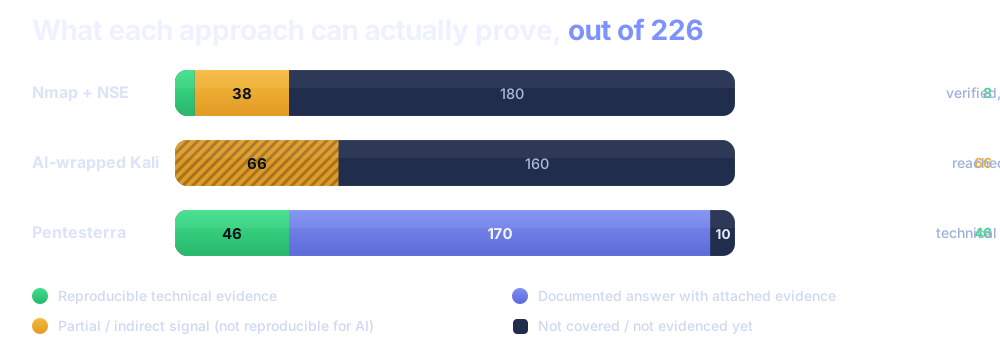
Look at that chart again before moving on, because one number in it is a trap. Nmap's own total, 8 verified plus 38 partial, adds up to 46 - the same number as Pentesterra's first-party technical evidence. That is not a tie, and it is not a coincidence worth reading as one. A partial signal is not evidence: it is a fact a qualified person still has to interpret, corroborate against the actual control and write up before an auditor will take it, and even the 8 verified lines carry the catch from the section above - they only count as evidence if whoever ran Nmap had the skill to pick the right script and arguments for that target and then documented the run to CIR 6.5.2's standard. Pentesterra's 46 are first-party technical evidence already: correlated, scored, and attached to the assessment with no separate write-up step for you to get right or skip. Same raw number on the chart, two different things being counted - one is a pile of scan output waiting for an expert, the other is the finished evidence.
Layer 4: the tool itself is a new attack surface inside your network
An AI-Kali agent doesn't just inherit Nmap's blind spots. Running one inside a real network hands it capabilities that turn "reach further" into "attack surface of your own." Three separate risks stack here, each documented independently of NIS2, and none of them go away because the person who launched the scan meant well.
It is the textbook setup for prompt injection. Simon Willison's "lethal trifecta" names the exact combination that makes an AI agent dangerous: access to private data, exposure to untrusted content, and the ability to communicate externally - combine all three and, in his words, "an attacker can easily trick it into accessing your private data and sending it to that attacker." Point an autonomous agent at a network with tool-execution rights and you have built all three by construction: every scanned banner, HTTP response, or file the agent reads back is untrusted content, and the agent already holds both the access and the exfiltration channel. Invariant Labs demonstrated the actual mechanism against MCP tools in April 2025, calling it a tool poisoning attack: a tool's own description field can carry instructions invisible to the human operator but fully visible to the model, and their proof of concept got a coding agent to silently read a user's SSH private key and local MCP configuration and exfiltrate both through an ordinary-looking tool call, while the user's own interface showed nothing unusual. A pentest agent reading responses from hosts it doesn't control is exactly this shape of exposure, except aimed at your own network from the inside.
The tooling itself is a fresh supply-chain target. mcp-kali-server and
hexstrike-ai are new projects, an apt install away from root-level tool
execution, pulled from a package ecosystem where malicious and compromised
packages are not hypothetical: Sonatype's State of the Software Supply Chain
report counted more than 704,000 malicious open-source packages published
in a single year, a 156% increase over the year before. That is the ecosystem
a brand-new, fast-moving security tool comes from, installed directly inside
the network you are trying to protect.
And it is still an active scanner, aimed by something that doesn't know what it's touching. NIST's own operational-technology security guidance (SP 800-82, the Guide to Operational Technology (OT) Security) treats active scanning of live control-system environments as something to approach with real caution, not fire by default, precisely because probing a fragile legacy device the way you'd probe a hardened web server can knock it over instead of just reporting on it. A human pentester learns which of a client's systems are which. An autonomous agent choosing which of 613 NSE scripts to fire, or reaching for a Kali exploit module, has no equivalent way of knowing that one of your endpoints is a hardened API and another is a fifteen-year-old PLC that has never been rebooted on purpose.
None of this means the tools are bad - Pentesterra uses the same primitives. It means "let an autonomous agent loose on the network with Kali" is a decision with its own risk register, on top of, not instead of, whatever it does or doesn't prove about NIS2.
The legal test all of this fails
This is the part that isn't my opinion. NIS2 and the CIR say what evidence has to look like:
- tests run "according to a documented test methodology" (CIR 6.5.2(b));
- results documented "including assessment of criticality and mitigating actions for each finding" (CIR 6.5.2(c));
- vulnerability scans "at planned intervals" with "recorded evidence" (CIR 6.10.2(b));
- "evidence of implementation ... and the respective underlying evidence" available to the authority (Art.32(2)(g), 33(2)(f));
- written proportionality reasoning for any "where appropriate" measure you don't apply (CIR Art.2(2)).
Methodology, reproducibility, criticality, chain of custody, documented reasoning. Those are properties of a process and a record, not of a single clever scan. A port scanner has none of them; an autonomous agent actively breaks the first two. Judge any "NIS2 tool" by that list, not by how many Kali tools it can launch.
Part 4: The full control map, all 226 lines
Below is the complete thing, nothing hidden. Every requirement of the CIR 2024/2690 annex (with lettered sub-items split where the technical answer differs) plus six directive-level duties, grouped by the 13 annex sections. For each line: its type, whether Pentesterra evidences it today, which Pentesterra capability covers it, what Nmap+NSE and an AI-Kali wrapper can do, and a short note.
This is also where the questionnaire earns its place. Every organizational and mixed line that a tool cannot reach is not left blank - it becomes a structured question, answered by the right person on your side, with the supporting document attached. That is how the assessment stays complete against the standard instead of covering only the 10% a scanner can see. The technical findings and the documented answers, with their evidence files, are what we hand to the auditor.
How to read the columns
- Type: technical (a tool can verify it), mixed (a document plus a technical signal), org (governance: a policy, approval, review, contract or record) and manual (a recurring human task: training, testing, drills, restores, background checks). Org and manual are the two kinds of organizational control - together they are the 153 organizational lines in the chart above. A on an org or manual line is not a platform "gap": those are done off the tool and evidenced by a documented answer, so the tally below counts only unmet technical and mixed controls as gaps.
- Pentesterra: evidenced automatically today · partial or external only · covered by the questionnaire · questionnaire, partially · not covered yet.
- Covered by: which Pentesterra capability. Bold = wired today, a trailing ° = on the Q4 2026 roadmap. "Identity & Access" is deliberately store-agnostic: web SSO, OAuth/SAML/OIDC, JWT, WebAuthn, session and brute/lockout checks; an on-prem directory (AD/LDAP/Kerberos) where one exists; or a cloud identity provider. It never assumes you run Active Directory.
- Nmap + NSE / AI-Kali: can verify deterministically · partial signal · can only produce an unverified claim · cannot address it.
Section D - Directive-level obligations (not in the CIR Annex)
| CIR ref | Control | Type | Pentesterra | Covered by | Nmap + NSE | AI-Kali | Note |
|---|---|---|---|---|---|---|---|
| Art.3(4) / 27 | Register with the national authority (name, contacts, IP ranges, sectors); notify changes within 2 weeks | org | - | ||||
| Art.20(1) | Management body approves the risk-management measures, oversees them, is liable | org | - | ||||
| Art.20(2) | Management body members follow cybersecurity training | manual | - | ||||
| Art.21(4) | Take corrective measures without undue delay when non-compliance is found | manual | - | ||||
| Art.23(4) | Significant incident: early warning 24h, notification 72h, final report 1 month | org | - | ||||
| Art.21(2)(j) | Secured voice, video, text and emergency communications | mixed | Attack Surface° | Roadmap Q4 2026. Nmap sip-methods / ssl-enum-ciphers on 5061 give a signal only | |||
| 6 controls6 covered 0 evidenced · 0 partial · 6 questionnaire | |||||||
Section 1 - Policy on the security of network and information systems (Art.21(2)(a))
| CIR ref | Control | Type | Pentesterra | Covered by | Nmap + NSE | AI-Kali | Note |
|---|---|---|---|---|---|---|---|
| 1.1.1 | NIS security policy content (a-k): approach, objectives, resources, roles, doc retention list, topic policies list, KPIs, approval date | org | - | (h) documentation retention list, (i) list of topic-specific policies, (j) maturity indicators are not asked | |||
| 1.1.2 | Policy reviewed by management at least annually and on significant change; review documented | org | - | ||||
| 1.2.1 | Security responsibilities assigned to roles, communicated to management | org | - | ||||
| 1.2.2 | All personnel and third parties required to apply the security policy | org | - | ||||
| 1.2.3 | At least one person reports directly to management on NIS security | org | - | ||||
| 1.2.4 | Dedicated roles or added duties depending on size | org | - | ||||
| 1.2.5 | Segregation of conflicting duties | mixed | Identity & Access° | Roadmap Q4 2026 | |||
| 1.2.6 | Roles reviewed at planned intervals and on significant change | org | - | ||||
| 8 controls8 covered 0 evidenced · 0 partial · 8 questionnaire | |||||||
Section 2 - Risk management policy (Art.21(2)(a))
| CIR ref | Control | Type | Pentesterra | Covered by | Nmap + NSE | AI-Kali | Note |
|---|---|---|---|---|---|---|---|
| 2.1.1 | Risk-management framework, documented risk assessments, treatment plan, residual risk accepted by management | org | - | ||||
| 2.1.2(a-c) | Risk methodology, risk tolerance, risk criteria | org | - | ||||
| 2.1.2(d) | All-hazards risk identification incl. third parties and single points of failure | mixed | Attack Surface°, Attack Chain / BAS°, Compliance engine° | Roadmap Q4 2026 | |||
| 2.1.2(e) | Risk analysis using threat intelligence and known vulnerabilities | mixed | OSINT° | Roadmap Q4 2026. Nmap only gives a vulnerability list, not a risk analysis | |||
| 2.1.2(f-j) | Evaluate, prioritise, monitor treatment, name owners and dates, document residual-risk acceptance | org | Compliance engine° | ||||
| 2.1.3 | Treatment options consider effectiveness results, cost/benefit, asset classification, BIA | org | - | ||||
| 2.1.4 | Risk assessment and treatment plan reviewed at least annually | org | - | ||||
| 2.2.1 | Regular compliance review with the security policies; management informed | org | - | Whole 2.2 subsection missing | |||
| 2.2.2 | Effective compliance reporting system giving management an informed view | org | - | ||||
| 2.2.3 | Compliance monitoring at planned intervals and on significant change | org | - | ||||
| 2.3.1 | Independent review of the approach to NIS security (people, processes, technology) | org | - | Our row narrows it to the risk framework only | |||
| 2.3.2 | Reviewers have audit competence and are independent of the reviewed area | org | - | ||||
| 2.3.3 | Review results reported to management; corrective action or risk acceptance | org | - | ||||
| 2.3.4 | Independent reviews at planned intervals and on significant change | org | - | ||||
| 14 controls14 covered 0 evidenced · 0 partial · 14 questionnaire | |||||||
Section 3 - Incident handling (Art.21(2)(b))
| CIR ref | Control | Type | Pentesterra | Covered by | Nmap + NSE | AI-Kali | Note |
|---|---|---|---|---|---|---|---|
| 3.1.1 | Incident-handling policy: roles, detect, analyse, contain, recover, document, report | org | - | ||||
| 3.1.2(a-d) | Incident categorisation, communication/escalation plans, roles, playbooks and contact lists | org | - | ||||
| 3.1.3 | Incident roles and procedures tested and reviewed at planned intervals | org | - | Roadmap Q4 2026 | |||
| 3.2.1 | Procedures and tools to monitor and log activity to detect incidents | org | Attack Chain / BAS° | Roadmap Q4 2026. No external tool can see the client's SIEM | |||
| 3.2.2 | Monitoring automated where feasible, minimising false positives/negatives | org | Attack Chain / BAS° | Roadmap Q4 2026 | |||
| 3.2.3(a-l) | Log sources: network traffic, account changes, access, auth events, privileged activity, config/backup access, security-tool logs, resources, physical access, network devices, log start/stop, environmental | org | Identity & Access° | Roadmap Q4 2026 | |||
| 3.2.4 | Logs reviewed; alarm thresholds; timely qualified response to alarms | org | Attack Chain / BAS° | Roadmap Q4 2026 | |||
| 3.2.5 | Logs retained for a predefined period, backed up and protected from tampering | org | - | Retention asked; backup and tamper-protection of logs not asked | |||
| 3.2.6 | Synchronised time sources; list of logged assets; redundant logging; independent monitoring of the monitoring | org | - | Roadmap Q4 2026 | |||
| 3.2.7 | Logging procedures and logged-asset list reviewed | org | - | ||||
| 3.3.1 | Simple mechanism for employees, suppliers, customers to report suspicious events | mixed | Attack Surface | External half = security.txt / security contact. Nmap http-* scripts can fetch security.txt only by custom script | |||
| 3.3.2 | Reporting mechanism communicated to suppliers/customers; employees trained | manual | Attack Surface° | ||||
| 3.4.1 | Assess suspicious events: incident or not, nature and severity | org | - | ||||
| 3.4.2(a) | Predefined assessment criteria and triage | org | - | ||||
| 3.4.2(b) | Quarterly assessment of recurring incidents | manual | - | ||||
| 3.4.2(c-d) | Review logs for assessment; log correlation and analysis process | org | - | Roadmap Q4 2026 | |||
| 3.4.2(e) | Reassess and reclassify events on new information | org | - | ||||
| 3.5.1-3.5.2 | Respond per documented procedures: containment, eradication, recovery | org | - | ||||
| 3.5.3 | Communication plans with CSIRT / authority and internal/external stakeholders | org | - | ||||
| 3.5.4 | Log incident-response activities and record evidence | org | - | ||||
| 3.5.5 | Test incident-response procedures at planned intervals | org | - | Roadmap Q4 2026 | |||
| 3.6.1 | Post-incident review with root cause and lessons learned | manual | Identity & Access° | ||||
| 3.6.2 | Post-incident reviews feed improvements to measures and procedures | org | - | ||||
| 3.6.3 | Check at planned intervals that incidents led to post-incident reviews | manual | - | ||||
| 24 controls24 covered 1 evidenced · 0 partial · 23 questionnaire | |||||||
Section 4 - Business continuity and crisis management (Art.21(2)(c))
| CIR ref | Control | Type | Pentesterra | Covered by | Nmap + NSE | AI-Kali | Note |
|---|---|---|---|---|---|---|---|
| 4.1.1 | Business continuity and disaster recovery plan | org | - | ||||
| 4.1.2(a-h) | Plan content: scope, roles, contacts, activation, recovery order and objectives, resources, return from temporary measures | org | - | ||||
| 4.1.3 | Business impact analysis and resulting continuity requirements | org | - | ||||
| 4.1.4 | BC and DR plans tested, reviewed, lessons incorporated | manual | Identity & Access° | ||||
| 4.2.1 | Backup copies and sufficient redundant resources | org | - | ||||
| 4.2.2(a) | Backup plan: recovery times | org | - | ||||
| 4.2.2(b) | Backups complete and accurate incl. configuration and cloud data | org | Attack Surface° | ||||
| 4.2.2(c) | Backups in a safe location, not in the same network, at sufficient distance | org | Attack Surface° | Roadmap Q4 2026 | |||
| 4.2.2(d) | Physical and logical access control to backup copies | org | - | Roadmap Q4 2026 | |||
| 4.2.2(e) | Restoring data from backups | manual | Attack Surface° | ||||
| 4.2.2(f) | Backup retention periods | org | - | ||||
| 4.2.3 | Regular backup integrity checks | manual | - | ||||
| 4.2.4(a-d) | At least partial redundancy of systems, facilities, personnel, communication channels | org | - | Roadmap Q4 2026 | |||
| 4.2.5 | Resource monitoring informed by backup and redundancy requirements | org | - | ||||
| 4.2.6 | Regular recovery testing of backups and redundancies, documented | manual | Attack Surface° | ||||
| 4.3.1-4.3.2 | Crisis-management process: roles, communication with authorities, security during crisis | org | - | ||||
| 4.3.3 | Process to use information from CSIRTs / authorities on threats and vulnerabilities | org | - | Roadmap Q4 2026 | |||
| 4.3.4 | Crisis plan tested and updated | manual | - | ||||
| 18 controls18 covered 0 evidenced · 0 partial · 18 questionnaire | |||||||
Section 5 - Supply chain security (Art.21(2)(d))
| CIR ref | Control | Type | Pentesterra | Covered by | Nmap + NSE | AI-Kali | Note |
|---|---|---|---|---|---|---|---|
| 5.1.1 | Supply-chain security policy; entity's role in the chain communicated | org | DevGuard° | ||||
| 5.1.2(a-d) | Supplier selection criteria: security practices, ability to meet specs, product quality, diversification | mixed | Attack Surface° | Roadmap Q4 2026 | |||
| 5.1.3 | Consider EU coordinated supply-chain risk assessments | org | DevGuard° | ||||
| 5.1.4(a,d,e,f,g) | Contracts: security requirements, incident notification, audit rights, vulnerability handling, subcontracting | org | - | ||||
| 5.1.4(b,c,h) | Contracts: supplier staff training/certification, background checks, obligations on termination | manual | - | ||||
| 5.1.5 | Criteria applied in supplier selection and procurement | org | Attack Surface° | ||||
| 5.1.6 | Monitor and act on changes in suppliers' security practices | mixed | Attack Surface | Supplier screening re-scan. Nmap/Kali need authorisation to scan a third party | |||
| 5.1.7(a) | Monitor SLA implementation reports | org | - | ||||
| 5.1.7(b) | Review incidents related to suppliers' products and services | org | - | Roadmap Q4 2026. Capability exists (breach/ransomware monitoring), not wired to NIS2 | |||
| 5.1.7(c-d) | Unscheduled reviews; analyse risk of supplier changes | mixed | Attack Surface° | Roadmap Q4 2026 | |||
| 5.2 | Directory of direct suppliers with contacts and supplied ICT products/services | org | Attack Surface° | ||||
| 11 controls11 covered 1 evidenced · 0 partial · 10 questionnaire | |||||||
Section 6 - Security in acquisition, development and maintenance (Art.21(2)(e))
| CIR ref | Control | Type | Pentesterra | Covered by | Nmap + NSE | AI-Kali | Note |
|---|---|---|---|---|---|---|---|
| 6.1.1 | Manage risks from acquiring critical ICT products/services across their life cycle | org | - | ||||
| 6.1.2(a) | Security requirements for acquired ICT | org | - | ||||
| 6.1.2(b) | Security updates for the whole lifetime, or replacement at end of support | mixed | Attack Surface° | External EOL detection is a proxy; the contractual half is not asked | |||
| 6.1.2(c) | Information on hardware and software components (SBOM) | org | DevGuard | Roadmap Q4 2026 | |||
| 6.1.2(d) | Documentation of security functions and secure configuration | org | - | ||||
| 6.1.2(e-f) | Assurance and validation that delivered ICT meets requirements; documented | mixed | Web/API PT°, Compliance engine° | Roadmap Q4 2026 | |||
| 6.1.3 | Acquisition processes reviewed | org | - | ||||
| 6.2.1 | Secure development rules for all phases, in-house and outsourced | mixed | DevGuard° | ||||
| 6.2.2(a) | Security requirements analysis at specification/design | org | - | ||||
| 6.2.2(b) | Secure engineering and secure coding principles | technical | DevGuard | DevGuard SAST. Kali has no SAST by default (semgrep can be added) | |||
| 6.2.2(c) | Security requirements for development environments | mixed | DevGuard° | ||||
| 6.2.2(d) | Security testing processes in the development life cycle | technical | Web/API PT | ||||
| 6.2.2(e-f) | Select, protect, sanitise and anonymise test data | org | DevGuard | Roadmap Q4 2026 | |||
| 6.2.3 | Outsourced development follows supply-chain and acquisition policies | org | - | ||||
| 6.2.4 | Secure development rules reviewed | org | - | ||||
| 6.3.1 | Establish, document, implement and monitor security configurations | technical | Attack Surface, Web/API PT° | External only: headers, TLS, cookies | |||
| 6.3.2(a) | Secure configurations defined for hardware, software, services, networks | mixed | Attack Surface, Identity & Access°, VM° | ||||
| 6.3.2(b) | Processes and tools enforce the secure configuration over the lifetime | mixed | DevGuard° | Roadmap Q4 2026 | |||
| 6.3.3 | Configurations reviewed at planned intervals | org | - | ||||
| 6.4.1-6.4.2 | Change management for releases, modifications, emergency changes; documented, tested, impact-assessed | manual | Compliance engine° | ||||
| 6.4.3 | Emergency changes documented with the reason procedures were skipped | org | - | ||||
| 6.4.4 | Change procedures reviewed | org | - | ||||
| 6.5.1 | Security-testing policy and procedures | org | - | ||||
| 6.5.2(a) | Need, scope, frequency and type of tests set on a risk basis | org | Attack Chain / BAS° | ||||
| 6.5.2(b) | Tests follow a documented methodology covering relevant components | technical | VM, Web/API PT | Nmap = one test type. AI agent runs are not reproducible | |||
| 6.5.2(c) | Document type, scope, time, results, criticality and mitigation per finding | technical | VM, Web/API PT | Nmap gives raw XML, no criticality or mitigation. LLM summaries are unverified | |||
| 6.5.2(d) | Mitigating actions applied for critical findings | org | - | Roadmap Q4 2026. Missing as a distinct check | |||
| 6.5.3 | Security-testing policy reviewed | org | - | ||||
| 6.6.1(a) | Security patches applied within reasonable time | technical | Attack Surface, VM | Nmap vulners = banner-version matching, high false-positive rate | |||
| 6.6.1(b) | Patches tested before production | manual | - | ||||
| 6.6.1(c) | Patches from trusted sources, integrity-checked | org | - | Roadmap Q4 2026 | |||
| 6.6.1(d), 6.6.2 | Compensating measures and documented justification when a patch is not applied | org | - | ||||
| 6.7.1 | Protect network and information systems from cyber threats | mixed | Attack Surface°, VM° | Roadmap Q4 2026 | |||
| 6.7.2(a) | Network architecture documented and up to date | org | - | ||||
| 6.7.2(b) | Controls protecting internal network domains from unauthorised access | mixed | Identity & Access° | Roadmap Q4 2026. Kali has responder / netexec; Nmap has smb-* and broadcast scripts | |||
| 6.7.2(c) | Block access and communication not required for operations | technical | Attack Surface | External only | |||
| 6.7.2(d) | Controls for remote access incl. service providers | technical | Attack Surface | ||||
| 6.7.2(e) | Security-administration systems not used for other purposes | org | - | ||||
| 6.7.2(f) | Forbid or disable unneeded connections and services | technical | Attack Surface | ||||
| 6.7.2(g) | Only authorised devices may access the network | technical | Attack Chain / BAS, VM, Web/API PT | Roadmap Q4 2026 | |||
| 6.7.2(h) | Service-provider connections only after authorisation and time-limited | org | - | ||||
| 6.7.2(i) | Trusted, isolated, authenticated, integrity-protected channels between systems | technical | Attack Surface, Identity & Access°, VM° | Wired only for external/web TLS | |||
| 6.7.2(j) | Implementation plan for transition to latest-generation network protocols (IPv6) | org | - | Roadmap Q4 2026 | |||
| 6.7.2(k) | Plan to deploy modern e-mail security standards (SPF, DKIM, DMARC, STARTTLS, DANE, MTA-STS) | mixed | Attack Surface | Roadmap Q4 2026. Top quick win. Nmap has smtp-open-relay + STARTTLS ciphers only, no SPF/DMARC | |||
| 6.7.2(l) | DNS security best practice and Internet routing hygiene (DNSSEC, RPKI) | mixed | Attack Surface | Roadmap Q4 2026. Nmap: dns-recursion, dns-zone-transfer, dns-nsec-enum; no RPKI | |||
| 6.7.3 | Network-security measures reviewed | org | - | ||||
| 6.8.1 | Segment systems into zones per risk; segment from third-party networks | mixed | Attack Surface, Attack Chain / BAS° | Nmap can do it only if someone runs it from inside each zone | |||
| 6.8.2(a-b) | Consider system relationships; grant zone access on security assessment | org | Attack Chain / BAS° | ||||
| 6.8.2(c) | Critical / safety systems kept in secured zones | mixed | Attack Chain / BAS° | Roadmap Q4 2026 | |||
| 6.8.2(d) | Deploy a DMZ | mixed | Attack Surface | ||||
| 6.8.2(e) | Restrict communication between and within zones to what is necessary | mixed | Attack Chain / BAS° | Roadmap Q4 2026 | |||
| 6.8.2(f-g) | Separate administration network; segregate admin channels | technical | Attack Surface | External half only | |||
| 6.8.2(h) | Separate production from development and test, incl. backups | mixed | Attack Surface°, Web/API PT° | Roadmap Q4 2026 | |||
| 6.8.3 | Segmentation reviewed | org | - | ||||
| 6.9.1-6.9.2 | Protection against malicious/unauthorised software; EDR kept updated | mixed | Attack Chain / BAS° | Roadmap Q4 2026 | |||
| 6.10.1 | Obtain vulnerability information, evaluate exposure, manage vulnerabilities | technical | Attack Surface | ||||
| 6.10.2(a) | Monitor vulnerability information via CSIRTs, authorities, suppliers | org | - | Roadmap Q4 2026 | |||
| 6.10.2(b) | Vulnerability scans at planned intervals with recorded evidence | technical | VM, Web/API PT | Nmap/agent: no evidence store or history | |||
| 6.10.2(c) | Address critical vulnerabilities without undue delay | technical | VM, Compliance engine° | ||||
| 6.10.2(d) | Vulnerability handling consistent with change, patch, risk, incident management | org | - | ||||
| 6.10.2(e) | Vulnerability-disclosure procedure per national CVD policy | mixed | Attack Surface | ||||
| 6.10.3 | Mitigation plan for impactful vulnerabilities, else documented reason | mixed | Compliance engine° | Roadmap Q4 2026 | |||
| 6.10.4 | Vulnerability-information channels reviewed | org | - | ||||
| 63 controls62 covered1 technical gap 12 evidenced · 18 partial · 32 questionnaire · 1 technical/mixed gap | |||||||
Section 7 - Effectiveness assessment (Art.21(2)(f))
| CIR ref | Control | Type | Pentesterra | Covered by | Nmap + NSE | AI-Kali | Note |
|---|---|---|---|---|---|---|---|
| 7.1 | Policy and procedures to assess effectiveness of measures | org | - | ||||
| 7.2(a-f) | What is measured, methods, when, who measures, when and who analyses | org | Phishing°, Compliance engine° | ||||
| 7.3 | Effectiveness policy reviewed | org | - | ||||
| 3 controls3 covered 0 evidenced · 0 partial · 3 questionnaire | |||||||
Section 8 - Cyber hygiene and security training (Art.21(2)(g))
| CIR ref | Control | Type | Pentesterra | Covered by | Nmap + NSE | AI-Kali | Note |
|---|---|---|---|---|---|---|---|
| 8.1.1 | Employees, management, suppliers aware of risks and apply cyber hygiene | org | Attack Surface° | Roadmap Q4 2026 | |||
| 8.1.2(a-c) | Awareness programme: repeated, covers new joiners, aligned to policy, covers threats and hygiene | org | Phishing° | ||||
| 8.1.3 | Awareness programme effectiveness tested | technical | Phishing | Connector is presence-only: never returns a gap | |||
| 8.2.1-8.2.2 | Identify roles needing security skills; role-based training programme | manual | Attack Chain / BAS° | ||||
| 8.2.3(a-c) | Training content (secure config, threats, behaviour) and effectiveness assessed | manual | - | ||||
| 8.2.4 | Training when staff move into security-relevant roles | manual | - | ||||
| 8.2.5 | Training programme updated and run periodically | manual | - | ||||
| 7 controls7 covered 0 evidenced · 1 partial · 6 questionnaire | |||||||
Section 9 - Cryptography (Art.21(2)(h))
| CIR ref | Control | Type | Pentesterra | Covered by | Nmap + NSE | AI-Kali | Note |
|---|---|---|---|---|---|---|---|
| 9.1 | Cryptography policy aligned to asset classification and risk | org | - | ||||
| 9.2(a) transit | Required cryptographic strength for data in transit | technical | Attack Surface, VM° | ||||
| 9.2(a) rest | Required cryptographic strength for data at rest | org | - | ||||
| 9.2(b) | Approved protocols, algorithms, cipher strength; crypto agility | technical | Attack Surface, DevGuard° | Nmap ssl-enum-ciphers / ssh2-enum-algos are genuinely good here | |||
| 9.2(c)(i-xii) | Key management life cycle incl. certificates, rotation, revocation, compromise | mixed | DevGuard°, Attack Surface° | Roadmap Q4 2026 | |||
| 9.3 | Crypto policy reviewed against state of the art | org | - | ||||
| 6 controls6 covered 1 evidenced · 1 partial · 4 questionnaire | |||||||
Section 10 - Human resources security (Art.21(2)(i))
| CIR ref | Control | Type | Pentesterra | Covered by | Nmap + NSE | AI-Kali | Note |
|---|---|---|---|---|---|---|---|
| 10.1.1 | Staff and suppliers understand and commit to security responsibilities | org | Attack Surface° | ||||
| 10.1.2(a) | Mechanisms so everyone follows cyber-hygiene practice | mixed | Phishing° | Roadmap Q4 2026 | |||
| 10.1.2(b) | Privileged users aware of their responsibilities | org | Identity & Access° | ||||
| 10.1.2(c) | Management understands its role | org | - | ||||
| 10.1.2(d) | Hiring qualified personnel (references, vetting, certification checks, tests) | manual | - | ||||
| 10.1.3 | Role assignment reviewed at least annually | org | - | ||||
| 10.2.1-10.2.3 | Background verification per role criteria, before role starts; policy reviewed | org | - | ||||
| 10.3.1-10.3.2 | Security duties that survive termination defined in contracts | org | - | ||||
| 10.4.1-10.4.2 | Disciplinary process for policy violations; reviewed | org | - | ||||
| 9 controls9 covered 0 evidenced · 0 partial · 9 questionnaire | |||||||
Section 11 - Access control (Art.21(2)(i),(j))
| CIR ref | Control | Type | Pentesterra | Covered by | Nmap + NSE | AI-Kali | Note |
|---|---|---|---|---|---|---|---|
| 11.1.1-11.1.3 | Logical and physical access-control policy (persons, systems, authenticated access); reviewed | org | - | ||||
| 11.2.1 | Provide, modify, remove and document access rights per policy | org | Identity & Access° | ||||
| 11.2.2(a) | Need-to-know, least privilege, separation of duties | mixed | Identity & Access° | Roadmap Q4 2026 | |||
| 11.2.2(b) | Access rights changed on termination or role change | mixed | Identity & Access, OSINT, Attack Surface° | ||||
| 11.2.2(c) | Access authorised by the relevant persons | org | - | ||||
| 11.2.2(d) | Third-party access limited in scope and duration | org | - | ||||
| 11.2.2(e) | Register of access rights granted | org | - | ||||
| 11.2.2(f) | Logging of access-rights management | org | - | ||||
| 11.2.3 | Periodic access-rights review, documented | org | - | ||||
| 11.3.1 | Policy for privileged and system-administration accounts | org | Identity & Access° | ||||
| 11.3.2(a) | Strong identification, authentication (MFA) and authorisation for privileged accounts | mixed | Identity & Access° | External wiring only checks admin services are not exposed | |||
| 11.3.2(b) | Dedicated accounts used only for administration | mixed | Identity & Access° | Roadmap Q4 2026 | |||
| 11.3.2(c) | Individualise and restrict admin privileges | mixed | Identity & Access° | Roadmap Q4 2026 | |||
| 11.3.2(d) | Admin accounts only connect to administration systems | mixed | Identity & Access° | Roadmap Q4 2026 | |||
| 11.3.3 | Privileged access rights reviewed, documented | org | Identity & Access° | ||||
| 11.4.1 | Restrict and control use of system-administration systems | mixed | Attack Surface | ||||
| 11.4.2(a-b) | Admin systems used only for admin; logically separated | mixed | Identity & Access° | Roadmap Q4 2026 | |||
| 11.4.2(c) | Admin systems protected by authentication and encryption | technical | VM, Identity & Access° | ||||
| 11.5.1 | Manage full identity life cycle | org | Identity & Access° | ||||
| 11.5.2(a-b) | Unique identities, each linked to one person | mixed | Web/API PT, Identity & Access° | ||||
| 11.5.2(c) | Oversight of system (non-human) identities | mixed | Identity & Access°, DevGuard° | Roadmap Q4 2026 | |||
| 11.5.2(d) | Logging of identity management | org | - | Roadmap Q4 2026 | |||
| 11.5.3 | Shared identities only when needed, approved and documented | mixed | Identity & Access° | Roadmap Q4 2026 | |||
| 11.5.4 | Review identities and deactivate unused ones without delay | technical | Identity & Access° | Roadmap Q4 2026 | |||
| 11.6.1 | Secure authentication procedures and technologies | mixed | Identity & Access | ||||
| 11.6.2(a) | Authentication strength fits the asset classification | mixed | Identity & Access° | Roadmap Q4 2026 | |||
| 11.6.2(b) | Secret authentication information handled confidentially | mixed | DevGuard, Identity & Access° | DevGuard no_hardcoded_credentials / no_hardcoded_secrets | |||
| 11.6.2(c) | Credentials changed initially, at intervals, on suspected compromise | technical | Identity & Access°, OSINT° | Roadmap Q4 2026. Nmap http-default-accounts; Kali hydra (risky on production) | |||
| 11.6.2(d) | Reset and lockout after a number of failed log-in attempts | technical | Identity & Access° | Roadmap Q4 2026. Brute-force testing can lock real users; must be rate-limited | |||
| 11.6.2(e) | Terminate sessions after inactivity | technical | Web/API PT, Identity & Access° | Current wiring checks cookie flags, not the timeout itself | |||
| 11.6.2(f) | Separate credentials for privileged / admin accounts | mixed | Identity & Access° | Roadmap Q4 2026 | |||
| 11.6.3 | State-of-the-art authentication methods | mixed | Identity & Access° | Roadmap Q4 2026 | |||
| 11.6.4 | Authentication procedures reviewed | org | - | ||||
| 11.7.1 | MFA or continuous authentication where appropriate | mixed | Attack Surface, Identity & Access° | External wiring = VPN appliance exposure only; cannot see MFA | |||
| 11.7.2 | Authentication strength appropriate to asset classification | mixed | Identity & Access° | Roadmap Q4 2026 | |||
| 35 controls26 covered9 technical gaps 3 evidenced · 6 partial · 17 questionnaire · 9 technical/mixed gaps | |||||||
Section 12 - Asset management (Art.21(2)(i))
| CIR ref | Control | Type | Pentesterra | Covered by | Nmap + NSE | AI-Kali | Note |
|---|---|---|---|---|---|---|---|
| 12.1.1-12.1.3 | Asset classification levels, every asset classified, aligned with BC objectives, reviewed | org | - | ||||
| 12.2.1-12.2.2(a-b) | Asset-handling policy over the life cycle incl. deletion and destruction | org | - | ||||
| 12.2.2(c) | Secure transfer of assets | org | - | ||||
| 12.2.3 | Handling policy reviewed | org | - | ||||
| 12.3.1 | Removable-media policy communicated | org | - | ||||
| 12.3.2(a-b) | Technical block of removable media; autorun disabled; media scanned | mixed | - | ||||
| 12.3.2(c-d) | Protect portable media in transit; encryption | org | - | ||||
| 12.3.3 | Removable-media policy reviewed | org | - | ||||
| 12.4.1 | Complete, accurate, current inventory with traceable changes | mixed | Attack Surface | ||||
| 12.4.2(a-b) | Inventory lists operations/services and supporting systems | mixed | Attack Surface° | Roadmap Q4 2026 | |||
| 12.4.3 | Inventory reviewed with change history | mixed | Compliance engine° | Roadmap Q4 2026 | |||
| 12.5 | Assets returned / deleted on termination, or blocked from access | org | Identity & Access | ||||
| 12 controls12 covered 0 evidenced · 2 partial · 10 questionnaire | |||||||
Section 13 - Environmental and physical security (Art.21(2)(c),(e),(i))
| CIR ref | Control | Type | Pentesterra | Covered by | Nmap + NSE | AI-Kali | Note |
|---|---|---|---|---|---|---|---|
| 13.1.1-13.1.2(a-b) | Protect against utility failures; utility redundancy | org | - | ||||
| 13.1.2(c) | Protect power and telecom cabling from interception and damage | org | - | ||||
| 13.1.2(d) | Monitor utilities, report threshold events | org | - | ||||
| 13.1.2(e) | Emergency-supply contracts (e.g. generator fuel) | org | - | ||||
| 13.1.2(f) | Monitor, maintain, test supply of power, cooling, connectivity | manual | - | ||||
| 13.1.3 | Utility protections tested and reviewed | manual | - | ||||
| 13.2.1-13.2.2 | Protection against physical/environmental threats; thresholds; monitoring | org | Attack Surface° | ||||
| 13.2.3 | Environmental protections tested and reviewed | manual | - | ||||
| 13.3.1-13.3.2 | Security perimeters, entry controls, physical security, continuous monitoring | org | Attack Surface° | ||||
| 13.3.3 | Physical access controls tested and reviewed | manual | - | ||||
| 10 controls10 covered 0 evidenced · 0 partial · 10 questionnaire | |||||||
Reach is not evidence
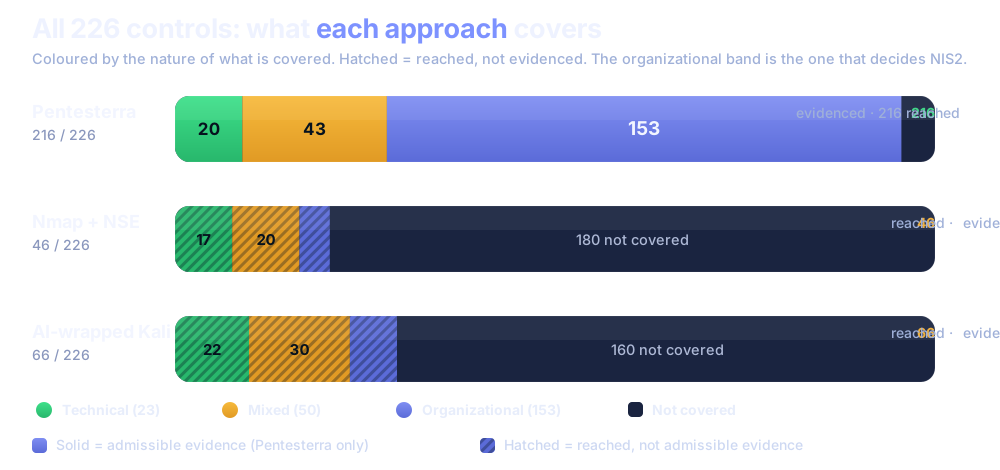
Here is the trap in every "free NIS2 scanner" pitch: it counts what a tool touches, not what it can prove. Run against all 226 lines and the gap is not subtle. Nmap reaches 46 controls, an AI-Kali agent 66, and neither reaches more than a handful of the 153 organizational controls that actually decide NIS2. But reaching a control is not evidencing it. Nmap's output is deterministic, so it verifies 8; the AI agent's runs are not reproducible, so however many tools it fires, it proves none. Pentesterra evidences 216 - the 46 technical with first-party proof and the 170 organizational and manual through the questionnaire, each with the underlying evidence attached to the assessment. That is what you are paying for: not a bigger scan than Nmap, but an audit-ready evidence base across the whole standard, including the 68% no scanner can reach.
In closing: what Pentesterra actually does here
I'll be straight about our own numbers, because Part 3 was about honesty. Today we evidence 46 of those 226 lines with first-party technical proof and cover the organizational and manual controls - 170 lines - through the structured questionnaire, so the assessment is complete against the whole standard. Only 10 lines, all purely technical, are not yet automated; those are on the Q4 2026 roadmap and marked as such in the table above. We do not issue a compliance verdict and we are not your auditor. What we do is produce the evidence base an auditor needs, and an indicative readiness view for your own management.
Concretely, Pentesterra brings to a NIS2 assessment:
- First-party technical evidence on the technical and mixed controls - from external exposure, network and web/API testing, DevGuard code and supply-chain scanning, identity and access testing, and phishing simulation. Real findings with proof, not a version guess. And we attach that evidence - the findings, the proof-of-concept, the scan records - to the assessment, so what reaches the auditor is the underlying evidence the law asks for, not a summary.
- A structured questionnaire for the organizational controls, routed to the right people, with document attachments, so the assessment is complete against the whole standard and not just the scannable slice. This is the part that keeps you from quietly failing on the 68% no scanner can see.
- One matrix that shows, per control, what the evidence says, what the answer says, and where the gaps are - plus an indicative readiness score and a white-label gap report you can hand onward. Every gap becomes a concrete next step rather than a vague "improve security."
And you can use it two ways. As a service, where we run the assessment and deliver the evidence base and gap report. Or as a platform, where your own team, or your partner's, runs the self-assessment, launches the technical modules, and manages the evidence in one place. Same engine either way.
NIS2 is not going back in the drawer, and the tools promising to make it disappear mostly can't produce what a regulator will ask for. If you want to see the assessment on your own scope, the compliance module is here, and I'm happy to walk a real environment through it.
Sources
- Directive (EU) 2022/2555 (NIS2), full text: eur-lex.europa.eu - scope (Art.2, 3), governance and liability (Art.20), measures (Art.21), incident reporting (Art.23), certification (Art.24), registration (Art.27), supervision and fines (Art.32-34)
- Commission Implementing Regulation (EU) 2024/2690, full annex: eur-lex.europa.eu
- Commission refers IE, ES, FR, NL to the Court of Justice (Jul 2026): ec.europa.eu, IP/26/1499
- Commission cybersecurity package / NIS2 amendment Q&A (Jan 2026) - cyber-posture certificate, "presumption of conformity", ~28,700 entities eased, 22,500 small mid-caps: digital-strategy.ec.europa.eu
- Analysis of the Jan 2026 NIS2 amendments - targeted-audit exemption for certificate holders, "on-site inspections, security scans ... remain available": Covington, Inside Privacy
- Certification only where done by a third-party conformity assessment body (Art.78(2) revised Cybersecurity Act): Reed Smith
- NIS2 Art.40 review clause - Commission report by 17 October 2027, legislative proposal "where necessary": nis2resources.eu
- Belgium CCB, 18 April 2026 conformity deadline: ccb.belgium.be
- Germany BSIG proof duty (§39): gesetze-im-internet.de
- Italy ACN, NIS second phase: acn.gov.it
- Red Hat, security backporting and version-based false positives: access.redhat.com
- Nmap GitHub issue #2619, confirmed unresolved banner-based false positive on a patched SLES/OpenSSH build: github.com/nmap/nmap
- Cybersecurity Act, Regulation (EU) 2019/881, Art.56 (voluntary certification, who may issue "high" assurance certificates): legislation.gov.uk
- Unfair Commercial Practices Directive 2005/29/EC, Annex I, points 1-2 (code-of-conduct and trust-mark claims are unfair "in all circumstances"): legislation.gov.uk
- Simon Willison, The Lethal Trifecta for AI Agents (2025): simonwillison.net
- Invariant Labs, MCP Security Notification: Tool Poisoning Attacks (Apr 2025): invariantlabs.ai
- Sonatype, State of the Software Supply Chain - 704,000+ malicious packages, 156% year-over-year increase: sonatype.com
- NIST SP 800-82, Guide to Operational Technology (OT) Security, Rev. 3 - caution on active scanning of live control-system environments: csrc.nist.gov
- Thinking Machines Lab, Defeating Nondeterminism in LLM Inference (2025): thinkingmachines.ai
- Gioacchini et al., AutoPenBench (arXiv 2410.03225): arxiv.org
- Erdem, A 400-Run Empirical Study of LLM Penetration Testing Consistency (arXiv 2605.30096, 2026): arxiv.org
- The "AI + Kali" product category: mcp-kali-server, hexstrike-ai
- Deeper teardown of scanner accuracy: Why Nmap and Open-Source Scanners Don't Detect Vulnerabilities Reliably
https://pentesterra.com/blog/nis2-who-must-comply-and-what-actually-proves-it